What it does, and where it stops.
Three jobs done properly, and a clear line where a person takes over. Most of the work in building this went into the second half of that sentence.
Seconds, from your number, in their language.
A buyer messaging at eleven at night gets an answer at eleven at night. Not a bot greeting — an answer to the question they asked.
From your listings only
Every fact it states is one you have entered. Bedrooms, price, community, service charge, permit. If the answer is not on the record it says so plainly and brings in an agent, rather than guessing something plausible.
Arabic and English
It replies in whichever the buyer used. No language selector, no "for English press one" — it reads the message and answers it.
Inside Meta's rules
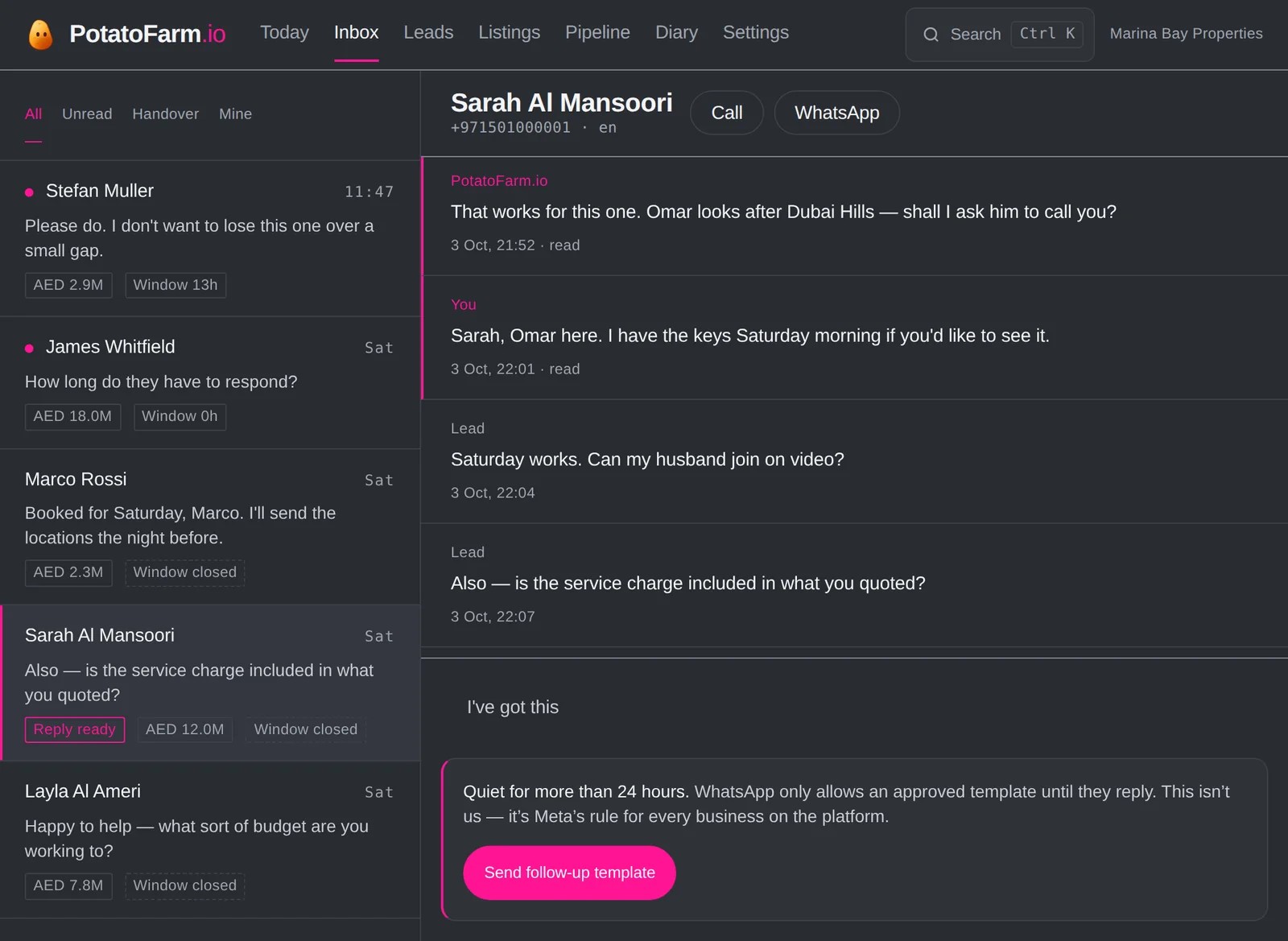
WhatsApp only permits free-form business replies within 24 hours of the customer's last message. Outside that window a message is accepted and silently never delivered. We track the window and show it on every conversation.
Yours, asked the way you would ask them.
You write the qualifying questions during setup. That is the part that makes it sound like your brokerage rather than like software, and it is the step we will not let you skip.
It asks them in conversation, in whatever order the exchange allows, and stops the moment it has what it needs. A buyer who volunteers their budget in the first message is not asked for it again.
Everything captured appears on the lead before your agent opens the conversation.
Answers, on the record.
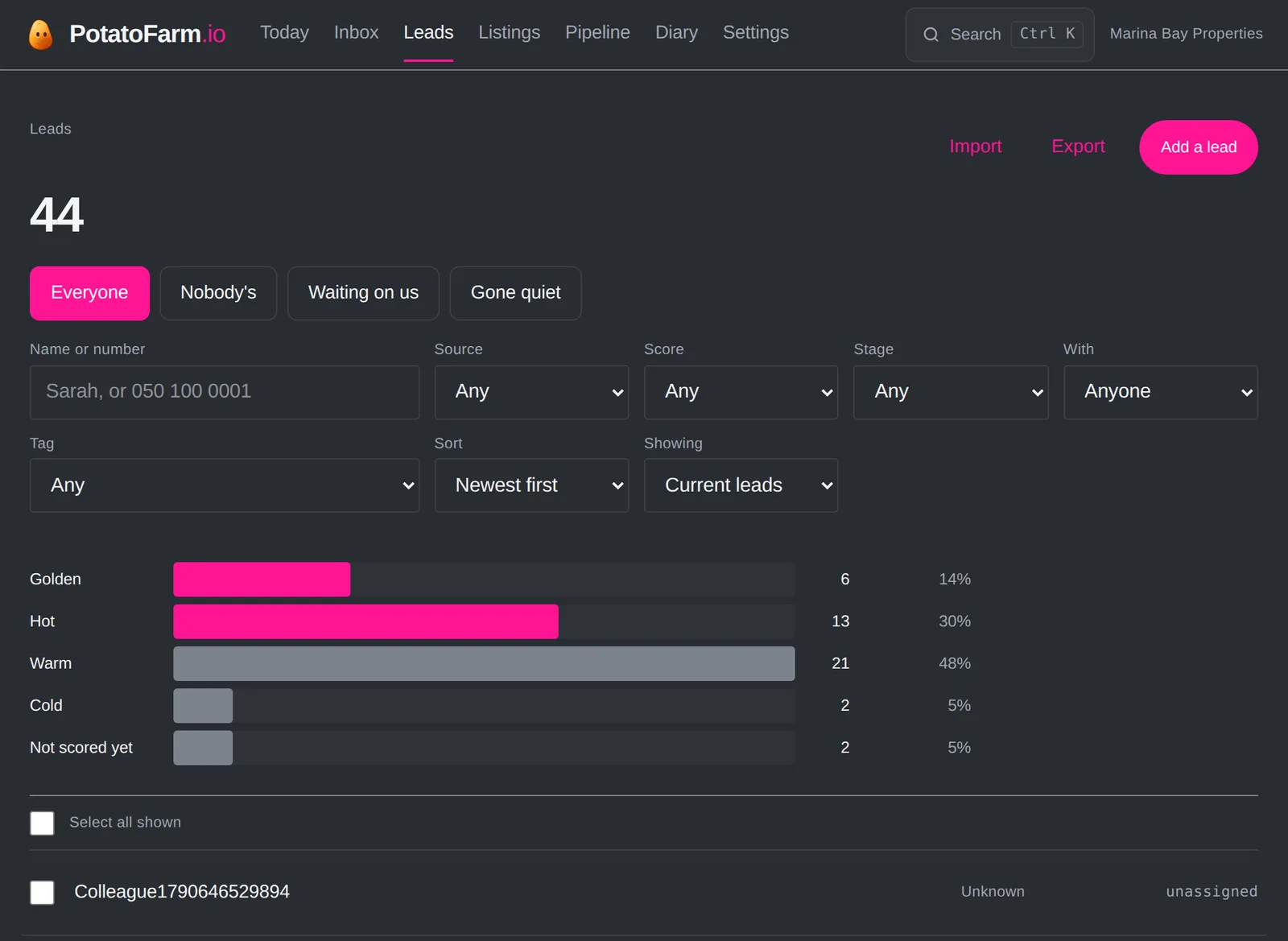
Everything the conversation established, against the person who said it — with the score, and the reason for the score, in words an agent can argue with.
It hands over on purpose, not on failure.
A price negotiation. A complaint. A question about a neighbour, a school catchment, or whether the landlord will take less. Anything it is not certain of.
In every case it stops, tells your agent why in one line, and the conversation is waiting for them with all of it already read. The buyer is told a colleague is picking it up — not left mid-sentence.
Every property, sent under your brand.
Each available property with a valid permit has its own page, under your brokerage's name. An agent sends it from the conversation in two taps, and WhatsApp shows a preview card with the property, its price and your name.
Your masthead, not ours
Your brokerage's name leads, with PotatoFarm.io signing the foot. The agent who looks after the property is named, with their RERA card.
The permit, on the advert
No valid Trakheesi permit, no page. The number is printed on every one, as the law requires of an advertisement.
The price that updates
Change the price on the listing and every link already sent shows the new one. A pasted paragraph never does.
A website of their own, run from the CRM.
Each agent can publish a personal microsite under your brokerage's name: their profile, the properties they pick from your stock, and Call, WhatsApp and a form that all lead back to them in the CRM.
The page beside the form
They write their profile, choose properties and areas, and see the page redraw as they type, phone-sized. Nothing goes public until they publish.
Leads that know where they came from
The form, and WhatsApp messages sent from the page, become leads assigned to that agent and credited to their microsite. A buyer another agent already has stays theirs.
Your rules, your name
Approve sites before they go live, choose which brand colours agents may use, decide whether they may use their own WhatsApp, and take any site down with a reason.
The half of the deal most systems ignore.
In Dubai, "won" is roughly the halfway point. Deals die between the Form F and the transfer, and almost always for the same reason: a step with a two-week lead time started one week before it was needed.
From the completion date
The Form F names a date, and missing it can cost the deposit. Everything is planned back from it rather than forward from today.
Before it is too late
A mortgage purchase where the seller also has a mortgage typically needs about 47 working days. A 30-day Form F is roughly 22. We say so before anyone signs.
The steps nobody remembers
The seller's liability letter. Service charge clearance before the NOC. The two things that quietly add three weeks and are discovered in week four.
What people ask before the first call.
Will buyers know it is not a person?
Many will, and it does not pretend otherwise. It never claims to be a named agent and never says it is human if asked directly. What matters to a buyer at eleven at night is that somebody answered — and the handover to a real agent happens fast enough that the distinction stops mattering.
What if it says something wrong?
It answers only from your listings, so the common failure — inventing a fact about a property — is structurally prevented rather than discouraged. If it does get something wrong, “Stop everything”, first on the Settings screen, halts every conversation immediately, and there is a full record of everything it said.
Does it replace an agent?
No, and a product that claimed to would be lying. It covers the ten minutes after an enquiry arrives, which is the window your agents cannot cover and your competitors are winning in. Everything that requires judgement stays with a person.
What does it cost?
$70 per agent per month, invoiced in dirhams at AED 257, with no VAT added. Each agent brings 60 conversations, pooled across the team; past that it is 35 fils each, about 9 US cents. There is no tier where the assistant works better and nothing held back to make a bigger number look reasonable. Fourteen days free with no card first, because the first week is us measuring your current response times rather than showing you features.
What happens if we switch it off?
Enquiries still arrive and still appear in your inbox. Nothing is lost and nothing stops working — the assistant simply stops replying, and your team answers as they did before.